
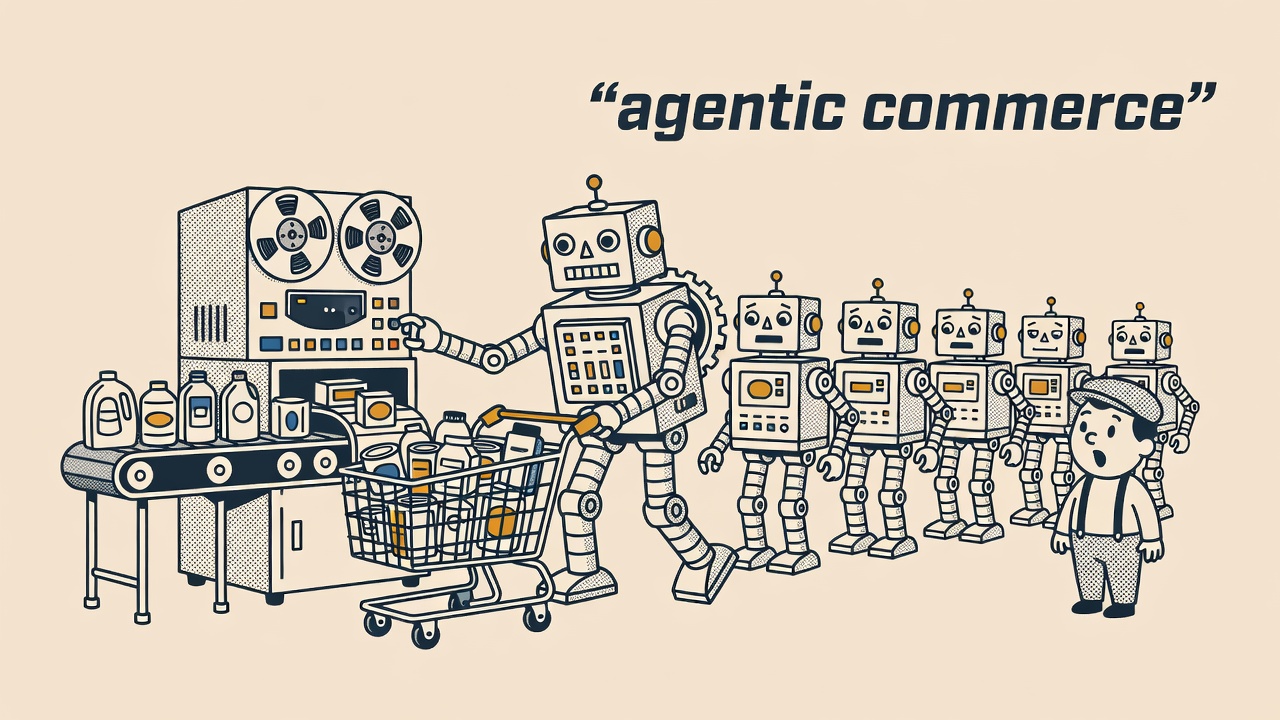
TL;DR: Agentic commerce puts AI agents in the role of shopper: they research, compare, and buy products on a person’s behalf. Store owners who expose clean, machine-readable product data and reliable APIs will show up in those agent-driven results. Those who don’t risk being skipped entirely.
Ecommerce is shifting again, and this time the person doing the browsing might not be a person at all. AI agents are beginning to search product catalogs, evaluate options, and place orders, often with minimal human input beyond setting a goal and a budget. If you run an online store, this shift will touch how you’re discovered, evaluated, and bought from.
What Is Agentic Commerce? A Plain-English Guide for Store Owners
Agentic commerce is ecommerce in which an AI agent acts on a shopper’s behalf to research products, compare options, and potentially complete a purchase with limited human intervention. The shopper sets an intent and a set of constraints, such as product type, budget, preferred brand, and delivery deadline. The agent handles the rest.
This is a meaningful departure from how most online shopping works today. When a person searches for a product, they click links, browse pages, read descriptions, and decide. An AI shopping agent skips that path. It queries product data programmatically, reasons across options, and can submit an order through an integrated checkout without the shopper ever landing on your storefront.
The key distinction between agentic commerce and a standard AI chatbot is execution capability. A chatbot answers questions. An AI shopping agent takes actions: querying multiple stores, checking live inventory, building a cart, and submitting an order within the permissions the shopper granted. That gap in capability is what makes agentic commerce a development worth understanding now, before it becomes the default.
Agentic commerce spans a continuum. At one end, an AI assists with discovery and recommendations while the human completes the purchase. Further along, the agent handles the full transaction autonomously. At the far end, agents transact with other agents, with no human in the loop at all.
The Four Layers of an Agentic Purchase
An agentic purchase moves through four functional layers: discovery, reasoning, checkout, and payment. Each layer is a point where your store either shows up or gets bypassed.
Discovery is where an AI agent identifies candidate products. It may query search engines, structured data embedded in your product pages, product feeds, or APIs that expose your catalog directly. If your product data is incomplete, inconsistent, or locked behind JavaScript rendering that a crawler cannot process cleanly, the agent may not find you.
Reasoning is where the agent evaluates what it found. It compares price, availability, shipping speed, return policy, and customer reviews, then filters results against the shopper’s stated constraints. Stores with accurate and detailed product information tend to fare better here, because the agent has more signal to work with.
Checkout is where a selected product must be purchasable programmatically. The agent needs access to cart creation, real-time pricing, shipping selection, inventory verification, and order submission. Payment follows: the agent processes payment using a secure, pre-authorized method such as a tokenized card, Shop Pay, Google Pay, or Apple Pay. Payment infrastructure that supports token-based authorization is a practical requirement for the checkout and payment layers to work reliably.
What Your Product Data Needs to Look Like
For a store to be visible to AI agents, the starting point is data quality. Your product catalog, prices, inventory status, variants, shipping details, and return policies all need to be accurate, complete, and machine-readable.
Machine-readable means more than having a live website. It means using structured data formats that AI systems can parse reliably. Schema.org’s Product markup gives you a shared vocabulary for describing products in a way search engines and AI systems both understand. Fields that matter most include product name, description, image, price, availability, brand, and review aggregate. Use JSON-LD to embed this markup in your pages. It is the format most AI parsers handle cleanly, and Google’s structured data documentation for products outlines exactly how to implement it correctly.
Beyond on-page markup, feeds matter. A well-maintained Google Merchant Center feed gives AI-powered shopping surfaces direct, structured access to your catalog. Shopify stores can generate this feed automatically, but you should audit it regularly for missing fields, mismatched GTINs, and prices that have drifted from your storefront.
APIs are the next frontier. Shopify’s Storefront API and Admin API let authorized systems query your catalog and inventory programmatically. BigCommerce and WooCommerce expose similar REST APIs. Merchants with reliable API access are better positioned as agentic checkout expands, because agents can retrieve live data rather than parsing rendered HTML pages. If you use a product information management system or inventory management system, confirm that the data it feeds to your APIs is as accurate as what a human would see on the product page.
Worth Knowing: Agentic discovery and agentic checkout are two separate problems with different timelines. Many stores will encounter AI-driven discovery, being found or skipped by an AI recommendation engine, long before full programmatic checkout becomes common. Start with data quality and schema markup now. The API and checkout infrastructure work can follow once you have solid foundations.
Agentic Checkout: What It Requires From Your Store
When a shopper delegates purchasing to an AI agent, your store must do more than appear in discovery results; it must be operable by software. An AI agent might recommend your products and send the shopper to your site, or it might complete the entire transaction through an integrated commerce flow without the shopper ever visiting your storefront. Both outcomes are realistic, and they carry different infrastructure requirements.
For agentic discovery, your priority is appearing accurately in AI-generated recommendations. That means clean product feeds, schema markup validated with Schema.org’s Markup Validator, and product descriptions detailed enough for an agent to reason about materials, dimensions, compatibility, and intended use.
For agentic checkout, you need programmatic cart and order management, real-time inventory signals, and payment methods that support secure token-based authorization. Protocols like the Agentic Commerce Protocol (ACP) and Universal Commerce Protocol (UCP) are emerging standards designed to let AI agents interact with merchant systems and complete checkout flows in a structured way. Both are still in early adoption, but merchants on API-first platforms will be better placed when they mature.
Fast, reliable checkout matters too. Agents tend to favor paths that complete without errors. A checkout flow burdened by unnecessary account creation prompts, slow page loads, or unclear error handling can cause an agent to abandon the transaction. This overlaps with what you already know about cart abandonment with human shoppers, the same friction points tend to cause problems for agents as well.
Pro tip from Ronen Abudi, e-commerce and GEO specialist (ronenabudi.com): Run your own product pages like an AI agent would: can you get price, availability, shipping estimate, and return policy from structured data alone in under 10 seconds? If you have to hunt for it, so does the agent. Fix those gaps before anything else.
Risks Every Merchant Should Plan For
Agentic commerce reduces friction for shoppers, but it creates new responsibilities for merchants. Consent and authentication come first. If an AI agent places an order on a customer’s behalf, your systems need to verify that the agent was actually authorized to do so. Standard session-based login flows were not designed for agent-initiated requests, and this is an area where your platform’s API security settings become important.
Fraud prevention follows. Automated purchasing can be exploited by scripted bots. Your fraud rules, rate limiting, and payment verification should account for non-human traffic patterns. Work with your payment processor, whether that is Stripe, Shop Pay, or another provider, to understand what signals they use to flag agent-initiated transactions and what documentation they may eventually require.
Returns and customer support carry their own complexity. If an agent made a purchasing decision based on inaccurate product data you published, the customer will expect you to fix it. Accurate catalog data is not just a visibility issue; it is a customer service issue with direct cost implications.
Attribution is an open question. When an AI agent drives a sale, standard last-click or UTM-based attribution may not capture it correctly. Set up your order management and analytics platforms to tag agent-initiated orders where possible, and monitor for gaps as AI shopping surfaces become more common.
How to Start Preparing Your Store for Agentic Commerce Today
You don’t need to rebuild everything at once. Start with an audit of your product feed in Google Merchant Center. Check it for missing fields, particularly descriptions, GTINs, and availability signals. Run a sample of key product pages through Google’s Rich Results Test to confirm your structured data is valid and rendering correctly.
Next, review your product descriptions. Agents reason from text. A thin description with no detail about materials, dimensions, compatibility, or use case gives an agent little signal to work with. Write descriptions that answer the questions a careful shopper would ask, because that is exactly what an AI agent evaluates when reasoning across options.
Then check your APIs. If you are on Shopify, BigCommerce, or WooCommerce, your platform already exposes API endpoints. Confirm that your catalog and inventory data in those endpoints matches what a human sees on the product page. Data that is accurate on the storefront but stale in the API can cause agent-driven orders to fail or return incorrect information.
Finally, monitor how AI systems represent your products. Run your brand name and top products through AI-powered search tools and check whether the results match your actual catalog. Discrepancies often point to structured data gaps or feed inconsistencies you can resolve without major technical work.
Quick Takeaways
- AI agents act on shoppers’ behalf, so your store must be readable by machines, not just by humans clicking through pages.
- Valid schema markup and well-maintained product feeds are your first line of defense against being skipped by AI recommendation engines.
- Programmatic checkout is still early-stage, but merchants with API-first platforms and clean inventory signals are ahead of the curve.
- Fraud rules, payment authorization flows, and attribution tracking all need review before agent-initiated traffic becomes a meaningful share of orders.
Frequently Asked Questions
- What is agentic commerce in simple terms?
- Agentic commerce is a model where an AI agent handles product research, comparison, and purchasing on behalf of a shopper, based on goals and limits the shopper sets in advance. The agent can query catalogs, build a cart, and submit an order programmatically, taking real actions rather than simply providing recommendations for a human to act on.
- How does an AI shopping agent differ from a regular chatbot?
- A standard AI chatbot provides information and answers questions but cannot act independently. An AI shopping agent goes further by executing tasks: querying product catalogs across multiple stores, filtering against set criteria, initiating a checkout, and completing a payment. The core distinction is execution capability rather than conversational skill.
- What product data must my store expose so AI agents can find it?
- Your store should provide accurate product names, detailed descriptions, prices, inventory status, variants, shipping estimates, and return policies in machine-readable formats. Schema.org Product markup in JSON-LD, up-to-date product feeds, and reliable API endpoints give AI agents structured access to your catalog without depending on page-scraping, which is both fragile and slower.
- What are the Agentic Commerce Protocol and Universal Commerce Protocol?
- The Agentic Commerce Protocol and Universal Commerce Protocol are emerging technical standards intended to allow AI agents to interact with merchant systems and complete checkout flows in a consistent, structured manner. Both remain in early adoption, but stores built on API-first platforms are better positioned to integrate with them as usage broadens across the commerce ecosystem.
- What risks does agentic commerce create for online store owners?
- Primary risks include unauthorized agent transactions if API authentication is not properly secured, fraud from scripted non-human buyers exploiting automated checkout paths, return disputes tied to inaccurate product data the agent relied on, and sales attribution gaps where AI-driven purchases are not tracked correctly in your analytics or order management system.