
TL;DR: The Shopify fee on a $100 sale using Shopify Payments on the Basic plan is $3.20, leaving you with $96.80 before subscription and product costs. Switch to a third-party gateway like PayPal or Stripe and total deductions jump to around $5.20 on the Basic plan, because Shopify layers its own transaction fee on top of the gateway’s processing charge.
Understanding the Shopify fee on a $100 sale is the first step toward pricing products that actually make money. Two variables control what gets deducted from every order: your Shopify plan tier, and whether you collect payment through Shopify Payments or an external gateway like PayPal or Stripe.
Breaking Down the Shopify Fee on a $100 Sale
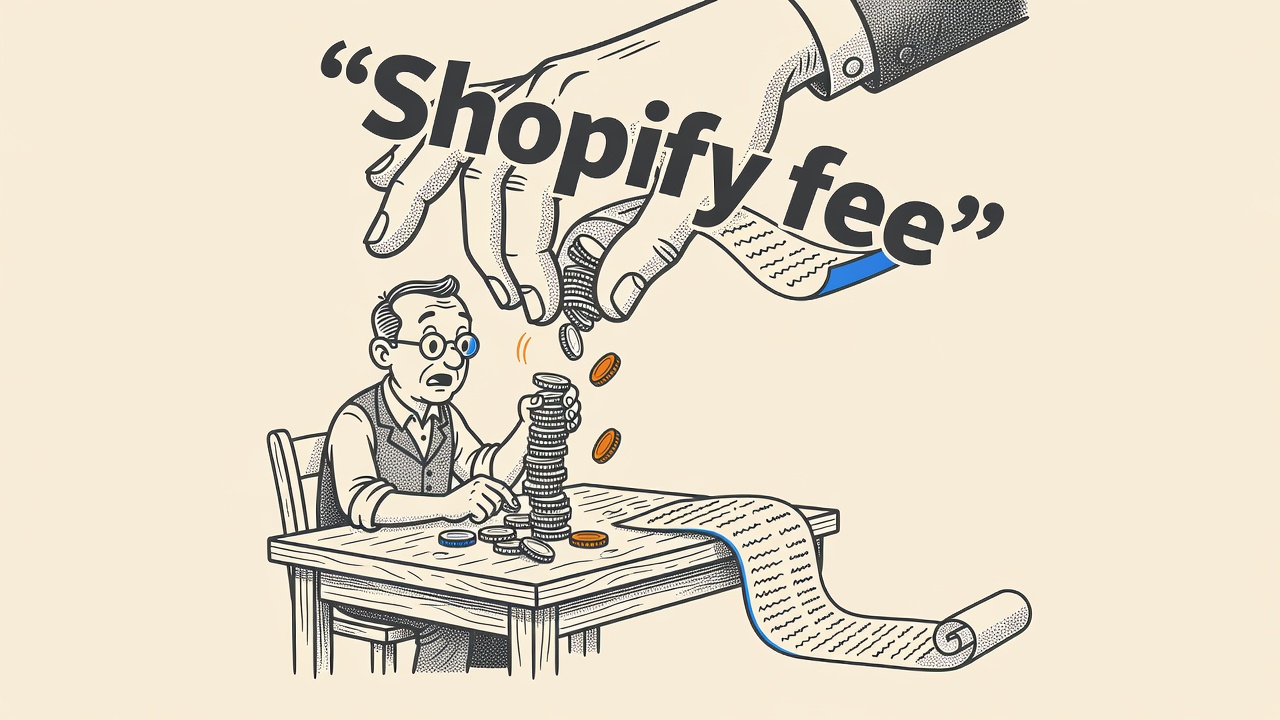
On a $100 Shopify order processed through Shopify Payments on the Basic plan, a single charge of $3.20 is deducted before the balance reaches your account. That figure comes from a 2.9% processing rate ($2.90) plus a flat $0.30 per-transaction fee, per the Shopify pricing page. No additional Shopify commission applies on top of that.
A Shopify processing fee is the per-transaction charge deducted from each order’s gross revenue before the payout reaches your Shopify balance, covering card-network costs, the issuing bank’s cut, and Shopify’s payment infrastructure. When you use Shopify Payments, you pay one combined fee that handles all of it. When you use a third-party gateway, you pay that gateway’s fee plus a separate Shopify transaction fee on the same order.
The $0.30 flat component of the Basic rate matters more at low order values than at high ones. On a $10 order, that $0.30 alone equals 3% of revenue. On a $100 order, it represents only 0.3%, making the effective fee rate more efficient as your average order value climbs. Many experienced sellers use bundling, upsells, and minimum order thresholds specifically to raise average order value and reduce their effective fee percentage per dollar collected.
Shopify Payments Fees Across Basic, Grow, and Advanced
Shopify’s per-transaction processing rate decreases at higher plan tiers. The Basic plan carries the highest rate because it comes with the lowest monthly subscription fee. Grow and Advanced offer lower per-transaction rates in exchange for higher fixed monthly costs. Whether that trade-off pays off depends entirely on how many orders you process each month.
Per Shopify’s pricing page, the estimated processing fee on a $100 online sale using Shopify Payments is approximately $3.20 on Basic, between $2.90 and $3.00 on Grow, and between $2.70 and $2.80 on Advanced. These figures reflect standard online card transactions. In-person rates are different and generally lower, and rates can also vary by country, card type, and Shopify Payments eligibility in a given market.
| Plan | Basic rate (Shopify Payments) | Fee on $100 sale | You keep (approx.) | Third-party gateway add-on |
|---|---|---|---|---|
| Basic | 2.9% + $0.30 | ~$3.20 | ~$96.80 | +2% |
| Grow | Lower rate | ~$2.90 to $3.00 | ~$97.00 to $97.10 | +1% |
| Advanced | Lower rate | ~$2.70 to $2.80 | ~$97.20 to $97.30 | +0.6% |
| Plus | Negotiated | Varies | Varies | +0.2% |
To find the break-even point between plans, divide the monthly cost difference by the per-order fee saving. If upgrading from Basic to Grow saves $0.25 per order and costs an extra set amount per month, you need at least that many orders before the upgrade pays for itself. Shopify’s pricing calculator, available on the Shopify pricing page, runs this math automatically when you enter your expected monthly order volume and average order value.
Third-Party Gateways and the Shopify Fee on a $100 Sale
Choosing PayPal, Stripe, or any other external payment provider introduces a second fee layer on every order. Shopify charges its own transaction fee on top of whatever your gateway charges, per the Shopify Help Center guide on third-party transaction fees. On the Basic plan, that additional Shopify charge is 2% of the order total, and it applies regardless of which external provider you choose.
As of writing, PayPal’s published standard online processing rate is 2.9% plus $0.30, which equals $3.20 on a $100 sale; confirm the current rate on PayPal’s fee schedule before calculating, as rates can change. Add Shopify’s Basic-plan transaction fee of 2%, which is $2.00 on a $100 order, and the combined total rises to $5.20. The merchant keeps approximately $94.80, compared to $96.80 when using Shopify Payments. That $2.00 gap grows quickly at volume, reaching $200 per month on 100 orders.
As of writing, Stripe’s standard published rate for online card transactions is also 2.9% plus $0.30, so the numbers on Basic are identical to the PayPal example: $3.20 from Stripe plus $2.00 from Shopify, totaling $5.20 in deductions on a $100 order. The Shopify transaction fee applies the same way to every third-party gateway, per Shopify’s Shopify Payments processing fees documentation. Switching to Shopify Payments is the only way to eliminate it entirely.
Worth Knowing: Shopify’s third-party transaction fee is calculated on the gross order total, including any shipping amount collected at checkout. If an order includes $100 in products and $15 in shipping, the 2% Basic-plan fee applies to $115, not just $100. For stores that collect shipping at checkout rather than offering free shipping, this inflates the effective transaction fee slightly. Build it into your shipping threshold math when you set free-shipping minimums.
How Much You Actually Keep From a $100 Shopify Sale
The monthly subscription is not deducted per sale, but it functions like a per-order overhead at lower sales volumes. At 20 orders per month, the plan cost spreads meaningfully across each transaction. At 200 orders per month, the same fixed cost becomes a small fraction per sale. Reviewing this math quarterly, using Shopify’s built-in pricing calculator, helps you catch the point where upgrading your plan becomes profitable.
Tracking your effective fee rate each month gives you a clearer number than the published rate alone. Divide your total Shopify fees paid (visible in the Shopify admin under Finances and then Payouts) by your gross revenue for the period. That effective rate captures processing fees, transaction fees, and any other Shopify charges together, so you can compare months and measure the real cost of any gateway or plan changes you make.
Pro tip from Ronen Abudi, e-commerce and GEO specialist (ronenabudi.com): Run your projected monthly order volume through Shopify’s pricing calculator before locking in a plan. The processing rate savings on Grow and Advanced only offset the higher subscription above a specific order threshold, and that threshold shifts whenever your average order value changes significantly.
What Else Cuts Into Your Profit Beyond Shopify’s Fees
Apps are a common and underestimated budget drain. Many stores accumulate review tools, loyalty programs, upsell apps, and email capture software, each carrying a monthly charge. A handful of mid-range apps can cost more per year than the fee difference between Shopify plan tiers. Audit installed apps regularly and remove any that are not generating measurable revenue or saving time.
Chargebacks are more costly than refunds. When a customer disputes a transaction with their bank, the sale amount is typically held during the dispute process and a chargeback fee may apply, per Shopify’s payment documentation. Unlike a standard refund, a chargeback can mean losing the product, the sale, and the original processing fee simultaneously. Keeping your chargeback rate low protects both your margin and your eligibility to continue using Shopify Payments.
Advertising spend is often the single largest variable cost for stores relying on paid traffic. A $3.20 processing fee on a $100 sale is predictable and manageable. A $30 customer acquisition cost on that same sale is a structural margin problem. Monitor return on ad spend and cost per acquisition inside your ad platform dashboards (Meta Ads Manager, Google Ads, TikTok Ads Manager) alongside your Shopify analytics. Shopify’s built-in Analytics section, under the Overview dashboard, shows sales by channel and average order value so you can see which traffic sources deliver profitable revenue rather than just volume.
Quick Takeaways
- Switching from a third-party gateway to Shopify Payments eliminates the extra 2% Basic-plan transaction fee, saving $2.00 on every $100 order and making it one of the fastest fee reductions available.
- The $0.30 flat fee per transaction becomes proportionally smaller as average order value rises, so upselling and bundling improve your effective rate without changing your plan.
- Upgrading to Grow or Advanced lowers processing costs but only pays off above a monthly order volume you can calculate in advance using Shopify’s pricing tool.
- Apps, chargebacks, ad spend, and shipping regularly consume more margin than Shopify’s processing fees; checking your Shopify Finances dashboard monthly keeps the full cost picture visible.
Frequently Asked Questions
- Does Shopify charge a percentage of every sale?
- Every online sale on Shopify carries a card-processing percentage, but it functions as a payment-network charge rather than a platform commission on your revenue. With Shopify Payments active, that one percentage covers the full transaction cost. With any third-party gateway, Shopify applies a separate additional percentage ranging from 2% on Basic down to 0.2% on Plus, as documented in Shopify’s Help Center, on top of whatever the gateway charges.
- What does 2.9% plus $0.30 actually equal on a $100 order?
- Multiplying $100 by 0.029 produces $2.90, and adding the fixed $0.30 per-transaction charge brings the deduction to exactly $3.20. That $3.20 is what Shopify deducts on the Basic plan for a standard online card sale through Shopify Payments, leaving a pre-cost payout of $96.80 in your account before subscription fees or product expenses are factored in.
- How does the combined fee work when using PayPal or Stripe on Shopify?
- Both PayPal and Stripe charge their own standard online processing fee, and Shopify layers its Basic-plan 2% transaction fee on top of that. If the gateway’s rate is 2.9% plus $0.30, the two fees together total roughly $5.20 on a $100 order, leaving about $94.80 before other costs. Activating Shopify Payments removes the Shopify portion of that combined charge entirely.
- Do Shopify fees change for international or currency-converted orders?
- Rates differ by country, card-issuer location, and whether Shopify Payments operates in that market. Cards issued outside your home country can carry additional card-network surcharges stacked on the base processing rate. Shopify publishes region-specific rate tables in its Help Center, so verify the documentation for your store’s country before estimating fees on cross-border sales, as the figures vary meaningfully by region.
- Does Shopify return the processing fee when a refund is issued?
- When you refund a customer through Shopify, the original processing fee is generally not returned to your balance. The $3.20 deducted on the initial $100 sale stays with the card network, meaning each refund costs you that fee even though no revenue is retained. Product categories with higher return rates carry an elevated effective fee rate once refunds are counted, which makes return-rate management a direct profitability lever.