
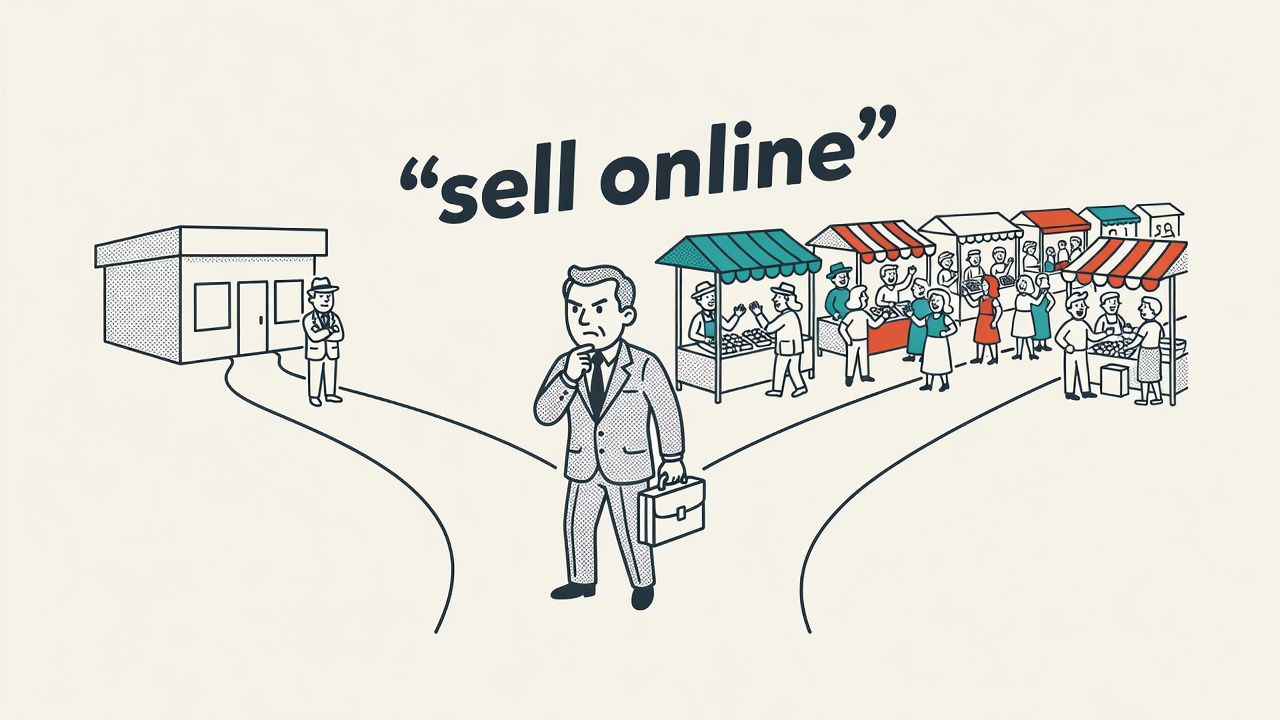
TL;DR: If you have no existing audience, start on a marketplace to prove product demand fast and earn your first sales with minimal setup. Then launch your own store to own customer data, build your brand, and keep more margin per sale. Most successful sellers run both channels in parallel.
The Question That Trips Up Most New Sellers
Deciding where to sell online first: your own store vs marketplaces is the most consequential strategic choice a new seller makes. Get it wrong and you spend months building on a platform that limits your margin, your data, and your growth. Get it right and you create genuine momentum from day one, with sales that teach you something useful about your product and your customers.
The good news is that this is not a permanent decision. Whichever channel you start with, you can and should add the other over time. The real question is which one gives you the most useful information and the most traction right now, with the resources you have today. That answer changes depending on your starting point, your product type, and your goals.
This guide walks through the real trade-offs on both sides, the situations where each option makes more sense, and the practical sequence most successful sellers use to build a business that does not depend entirely on a platform they do not control.
What Marketplaces Give You (And What They Keep)
Marketplaces solve the hardest problem in ecommerce for new sellers: traffic. Amazon alone draws over 2.5 billion visits per month. Etsy serves more than 90 million active buyers. When you list on these platforms, you place your products in front of shoppers who are already in buying mode, searching by keyword for exactly what you sell. No SEO required, no ad spend needed to get started, and no waiting months for Google to trust a brand-new domain.
But that access comes at a price. Amazon typically charges 8-15% in referral fees depending on category, plus fulfillment costs if you use FBA. Etsy charges a 6.5% transaction fee plus listing and payment processing fees. Those percentages compound across every sale. Beyond fees, you own very little of the customer relationship. The marketplace holds the buyer’s email address, controls the search algorithm, sets the rules, and can suspend your account or delist a product without warning. Competitors can also appear directly on your listing page and undercut you on price.
Marketplaces create intense price pressure. When shoppers can sort results by price and compare your product to ten similar ones instantly, differentiation becomes difficult. Winning on Amazon often means winning on price and review count, which is a race that compresses margins over time. Understanding these pressures is central to answering where to sell online first: your own store vs marketplaces, because the right answer depends heavily on how commoditized your product actually is.
What Running Your Own Store Actually Requires
Your own store removes the middleman. You set the price, design the experience, and capture customer emails, purchase history, and behavioral data directly. That data is enormously valuable. A growing email list pays dividends for years through repeat purchases and targeted campaigns. On a marketplace, that same data belongs to the platform, not to you.
Margins are meaningfully higher on your own store. Without a 10-15% marketplace commission taken off the top, you have more room to invest in ads, offer free shipping thresholds, or simply earn more per unit. Shopify starts at around $29 per month and charges approximately 2.9% plus 30 cents per transaction on standard plans. That is a small fraction of what a marketplace takes as your volume grows. WooCommerce is free to install on WordPress, though hosting costs apply separately.
The major challenge is traffic. Your store starts with zero audience. Every visitor must come from somewhere: Google search, paid ads, social media, email, influencer partnerships, or word of mouth. Building that traffic takes time, money, or both, often all three. A brand-new seller with no existing audience who opens a Shopify store and then waits for sales will be waiting a long time.
Worth Knowing: Launch your own store even while you are primarily selling on marketplaces. Set it up early, even with just a few products and a basic theme. When you are ready to shift customers to your own channel, the infrastructure is already live and your domain has been accumulating SEO authority. Sellers who wait too long have to start from zero after years of marketplace sales, losing all the organic search time they could have been building.
Where to Sell Online First: Your Own Store vs Marketplaces, Based on Your Situation
Your starting point determines the right answer more than anything else. If you have no existing audience, no email list, and no social following, a marketplace is almost always the smarter first step. You need to prove that real people will pay real money for your product before you invest in building out your own channel. A marketplace delivers that signal quickly, with buyers already present and actively searching.
If you already have an audience, starting with your own store often makes more sense. A YouTube channel, an email list from a previous business, or an engaged Instagram following in your niche means you can drive traffic on day one. In that case, skip the marketplace commissions entirely and start capturing customer data from your very first sale.
Product type matters too. Commoditized goods, items where shoppers compare prices and buy on convenience, tend to perform better on marketplaces where search intent is already high. Distinctive, brandable products, especially those where storytelling and presentation matter (apparel, wellness products, niche digital goods, handmade items, consumable subscriptions), do better on your own store over time. The U.S. Small Business Administration consistently emphasizes brand differentiation as a primary driver of long-term small business competitiveness. A brand is an asset that compounds. A low-price position on a marketplace does not.
The Hybrid Strategy That Most Successful Sellers Use
The either/or framing of where to sell online first: your own store vs marketplaces breaks down once you see how well the two channels work together. Smart operators use marketplaces as a discovery engine and their own store as the relationship and margin engine. A buyer finds them on Amazon or Etsy, likes the product, and buys once. Then a thoughtful packaging insert, a QR code, or a post-purchase follow-up (where platform rules permit) nudges that buyer toward the seller’s own store for the next purchase.
This approach works especially well for consumables and repeat-purchase products. A customer who buys a supplement on Amazon and then switches to ordering directly from the brand’s own site is worth dramatically more over their lifetime. FTC guidelines require transparency around incentivized referrals and reviews, so any insert card strategy must be honest and compliant. Driving satisfied customers to your own store after an initial marketplace purchase is completely legitimate and widely practiced by serious brands.
For digital products (ebooks, software, courses, templates, downloads), the same logic applies. Platforms like Gumroad and Payhip lower the barrier to entry and provide some marketplace-like audience effects. Starting there to build initial traction, then migrating buyers to your own site once you have a proven product and some reviews, is a sensible path. Data from the U.S. Census Bureau shows that nonemployer businesses in digital categories have grown sharply in recent years, reflecting exactly this dynamic: solo creators proving a product on a simple hosted platform before scaling to a full independent store.
Building a Roadmap That Actually Works
Here is a concrete sequence that works for most new sellers. In month one, list your top three to five products on the marketplace that best fits your category. Amazon for general goods, Etsy for handmade or vintage items, eBay for used or hard-to-find products. Keep prices competitive with existing listings. At this stage, your goal is data, not margin. You want to see which products move and which do not, and why.
In months two and three, open your own store. Do not wait for your marketplace sales to feel stable first. Set up a simple Shopify or WooCommerce site with your best-performing products and start building an email list immediately, even if it is small. A basic “subscribe for 10% off” opt-in begins capturing names from day one. Write honest, specific product descriptions optimized for search. This is the foundation of your owned audience, and the sooner it starts compounding, the better.
From month four onward, run both channels in parallel. Use marketplace revenue to fund your store’s early ad spend. Shift repeat-purchase and high-margin products toward your own store over time. Track where your most profitable customers come from and invest more in those channels. At that point, the original question of where to sell online first: your own store vs marketplaces becomes far less urgent, because you have real data telling you exactly where your best buyers live and how to reach more of them.
Quick Takeaways
- If you have no existing audience, start on a marketplace to validate demand before investing in your own store infrastructure.
- Your own store gives you customer data, brand control, and higher margins, but you must generate all your own traffic from scratch.
- Marketplace commissions typically run 6-15% per sale; your own store costs a flat monthly fee plus roughly 2.9% in payment processing.
- The hybrid approach (marketplace for discovery, own store for loyalty and repeat-purchase margin) is what most successful multi-year sellers use.
- Launch your own store early, even while primarily selling on marketplaces, so your domain starts accumulating SEO authority from day one.
Frequently Asked Questions
- Should I start selling on a marketplace or my own store first?
- For most beginners with no existing audience, a marketplace is the better first step. You get immediate access to buyers who are already searching, which lets you validate your product quickly without heavy upfront investment. Once you confirm demand, open your own store to capture customer data, build your brand, and improve your margins on repeat purchases.
- What fees should I expect on a marketplace vs my own store?
- Marketplace fees vary by platform but typically run 6-15% per sale in commissions, plus payment processing. Your own store on Shopify or WooCommerce costs a flat monthly subscription starting around $29, plus payment processing of roughly 2.9% plus 30 cents per transaction. On meaningful volume, the economics of your own store improve significantly compared to ongoing marketplace commissions.
- Can I sell on a marketplace and my own store at the same time?
- Yes, and most experienced sellers do exactly that. Running both channels is called a hybrid strategy. Marketplaces drive discovery and new customer acquisition, while your own store handles repeat purchases at better margins. The key is tracking where your most profitable customers originate and putting more resources into those channels as your business grows.
- How do I get traffic to my own online store?
- Traffic to your own store must come from sources you actively build: search engine optimization (SEO), paid advertising on Google or Meta, social media content, email marketing, or partnerships with influencers and affiliates. Unlike a marketplace, there is no built-in audience, so having a clear traffic plan before you invest heavily in your store is essential.
- When should I shift my main focus from a marketplace to my own store?
- Consider shifting focus to your own store when you have consistent marketplace sales proving product demand, an email list of at least a few hundred subscribers, and a plan for driving traffic. Do not wait for perfect conditions. A store launched early accumulates SEO authority and customer data that compounds over months and years, even if it starts small.