
TL;DR: Calculate your true cost per unit first, layer in competitor research and perceived customer value, then set a margin floor. Aim for at least 50% gross margin, use psychological pricing to lift conversions, and test prices on real traffic rather than guessing from the start.
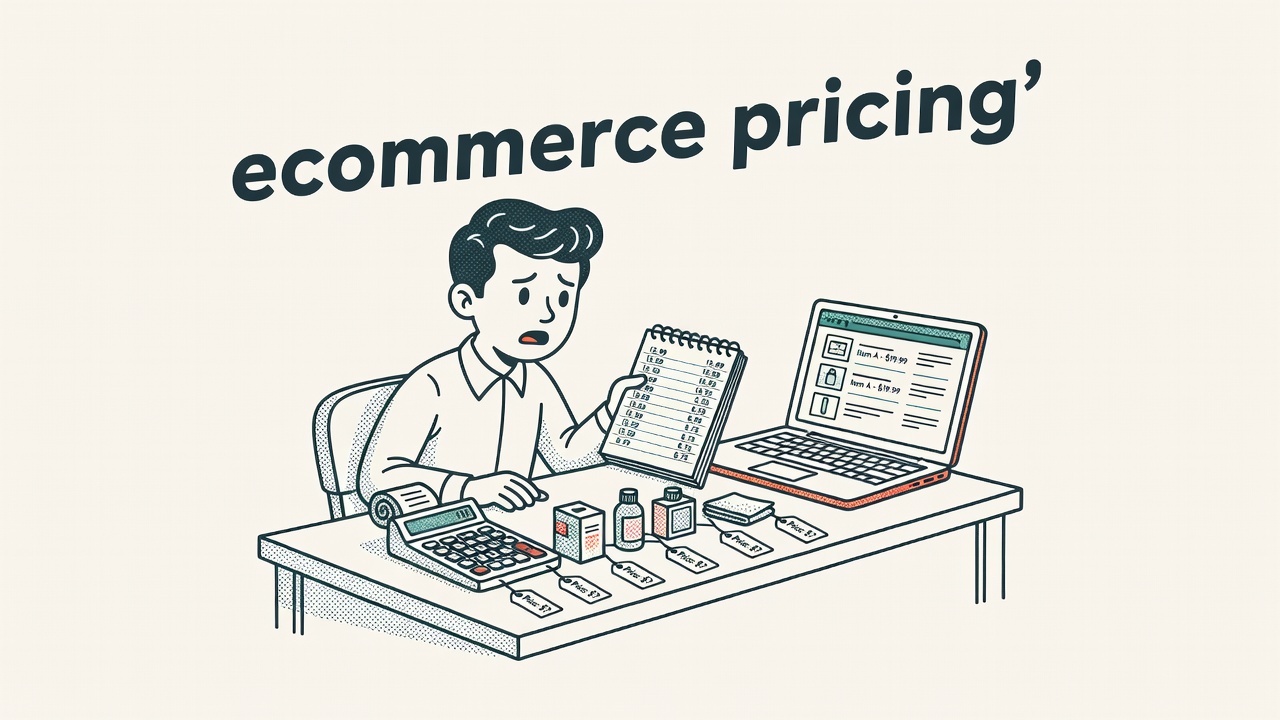
For ecommerce pricing beginners, the decision that most directly shapes whether month one is profitable or a hard lesson is where you set your prices. Price too low and you drain margins before you build any volume. Price too high without a clear reason and conversions stall. A structured three-input approach gives you a defensible number from day one.
What Ecommerce Pricing Beginners Miss in Their True Cost Per Unit
Cost per unit is the total it costs to acquire or produce one item and get it ready for sale, covering every fee from your supplier to your customer’s door. Most new sellers count only the wholesale price and miss several costs that quietly erase profitability before they realize it.
Your full cost per unit includes the product or manufacturing cost, packaging materials, inbound freight from your supplier, payment processing fees, platform or marketplace commissions, and a prorated share of monthly overhead. If your monthly software subscriptions, platform fees, and ad spend total $600 and you move 150 units, that adds $4 of overhead per unit before you have shipped a single order. Leaving it out means your margin calculations are always optimistic, never accurate.
Returns carry a hidden cost too. A common rule of thumb for physical goods is to allocate 1 to 3 percent of revenue as a returns buffer. It does not show up in a single transaction, but it shows up consistently across monthly statements. The U.S. Small Business Administration’s financial management guidance emphasizes building indirect costs into your baseline before setting any price, and returns are one cost many first-time sellers skip entirely.
Three Pricing Methods Every Ecommerce Beginner Needs to Understand
Three pricing methods cover most ecommerce situations: cost-plus, competitive, and value-based. Cost-plus sets a floor by adding a markup to your total costs. Competitive research gives you the market range. Value-based pricing acts as a ceiling based on what buyers believe the product is worth. A stronger pricing process combines all three rather than relying on just one.
Cost-plus pricing adds a fixed markup percentage to your total cost per unit. It is the simplest starting point for a new store because you always know you’re covering costs. The limitation is that markup alone ignores what the market will actually pay. A product costing $8 with a 50% margin target prices at $16, but if similar products sell at $11, you need to know that before launch.
Competitive pricing anchors your price to the market range. It prevents you from launching at a number that immediately signals something is off, but following competitors too closely can pull you into a price war on commodity products where no one wins on margin.
Value-based pricing asks what the customer believes the product is worth, independent of your cost. It works best when your product solves a specific problem, has a strong brand story, or offers noticeably better quality than alternatives. Done well, it produces the highest margins. Done without research, it means charging a premium the market will not support.
| Method | How It Works | Best For | Main Risk |
|---|---|---|---|
| Cost-Plus | Total cost plus a fixed markup percentage | New stores, straightforward products | Ignores market conditions entirely |
| Competitive | Price at or near the market average | Commodity or widely available items | Race to the bottom on margins |
| Value-Based | Price to the customer’s perceived value | Differentiated or branded products | Harder to validate without customer research |
How Ecommerce Pricing Beginners Should Research Competitor Prices Before Launch
Competitor research gives you the market price range your product needs to fit within before a single sale happens. Search Google Shopping, Amazon, and two or three niche stores in your category. Record the lowest price, the highest price, and the price most listings cluster around. That spread defines your market band before launch day.
Go deeper than the headline number. Check whether competitors include free shipping, what their return policies say, and whether bundle deals change the effective per-unit cost. A store listing at $18.99 with free shipping over $35 competes differently than one at $14.99 with $6.99 added at checkout. Customers compare the total delivered cost, not just the item price.
Tools like Prisync AI and PriceMole automate competitor price tracking at scale, but manual research across 5 to 10 competitors is enough before launch. The goal at this stage is to avoid launching at a number your market will reject on sight. Once you have real traffic, you can track prices more systematically with dedicated software.
Setting Your Margin Floor: The Ecommerce Pricing Beginner’s Guide to Not Losing Money
Your margin floor is the minimum selling price that keeps the business viable. To set it, you need two numbers: your break-even price, which covers all costs with zero profit, and your target gross margin, the percentage you need above that floor to fund ads, absorb returns, and pay yourself.
The standard formula used across ecommerce pricing guidance is:
Target selling price formula:
Selling Price = Total Cost ÷ (1 - Target Margin %)If your total cost per unit is $12 and you want a 50% gross margin, your selling price is $12 ÷ 0.50, which equals $24. Many ecommerce advisors recommend a 50% gross margin floor for new stores because it leaves room for paid advertising, occasional discounting, and returns without turning a good sales month into a loss. The U.S. Chamber of Commerce small-business pricing guide similarly stresses building enough markup to cover all indirect costs before chasing market positioning.
If the 50% floor prices you out of your market entirely, you have three real options: reduce your cost per unit through higher-volume supplier orders, cut overhead, or choose a product where the market price supports healthy margins from the start. Launching at thin margins and hoping volume saves you is a pattern that rarely ends well for new stores.
Worth Knowing: On Shopify, fill in the “Cost per item” field in each product’s Inventory section. The platform calculates your gross margin automatically and displays it next to your selling price. It also powers the “Compare at price” field, which shows customers a crossed-out reference price. Both fields feed into Shopify’s analytics reports so you can monitor margin by product without building a separate spreadsheet.
Psychological Pricing Tactics Every Ecommerce Beginner Should Try
Charm pricing (.99 endings) and compare-at pricing have the most consistent track record for ecommerce conversions, shifting buyer behavior without any change to the product itself. A few other tactics round out the toolkit for new stores.
Charm pricing, ending a price in .99 or .97 rather than a round number, is one of the most widely studied tactics in consumer psychology. Buyers read $29.99 as being closer to $29 than to $30, even when the difference is one cent. The compare-at price, showing a crossed-out higher number beside the selling price, frames the current price as a deal. Use this only when the reference price is real, such as a genuine prior price or a manufacturer’s suggested retail price. An invented anchor that customers can quickly verify as false destroys trust and hurts long-term conversion.
For higher-ticket items, breaking the price into a per-day or per-use frame reduces sticker shock. A $180 item framed as “about $15 a month” converts differently than a bare $180 listing with no context. This works because it shifts the mental comparison from a lump sum to a familiar recurring expense. Use whichever frame matches how customers actually think about the product’s role in their lives.
Should Ecommerce Beginners Launch Lower or Higher Than Competitors?
Launching below competitors is not the safe play it seems. A lower price signals lower quality to first-time buyers who have no prior information about your store. It also compresses your margin before you have the volume to offset it, and it trains early customers to expect a permanent discount. That is a hard pattern to unwind once it sets.
A better question to ask is: can you justify a price at or above the market midpoint? If your product arrives faster, uses better materials, or comes with a clearer use case and stronger product page than what is on the market, you can charge at or above the average and still convert well. If your product is functionally identical to what is available on Amazon with no story and no differentiation, competing on price alone is a difficult long-term position that gets harder as you scale.
The practical approach for most new stores is to launch at the middle of your market band, then test from there. A/B testing tools like Intelligems let Shopify merchants split-test prices on live traffic to see which converts better in practice rather than in theory. Track revenue per visitor alongside conversion rate. A lower price that lifts unit volume without improving revenue per visitor is not a pricing win. That data-driven cycle is central to ecommerce pricing for beginners who want margins that grow over time rather than shrink.
Quick Takeaways for Ecommerce Pricing Beginners
- Build your cost per unit from every component: product cost, packaging, inbound freight, payment fees, overhead share, and a 1 to 3 percent returns buffer. Wholesale price alone is never the full picture.
- Use three inputs together: cost-plus to set your floor, competitor research to map your market range, and value-based thinking to find your ceiling.
- Target a 50% gross margin floor so you have room for ads, discounts, and returns without turning good months into losses.
- Psychological pricing tactics like .99 endings and compare-at prices lift conversions without changing the underlying offer, but only work when the reference price is honest.
- Launch at the market midpoint and test from there with real traffic; track revenue per visitor and margin alongside unit sales to get an accurate picture of what a price change actually did.
Frequently Asked Questions: Ecommerce Pricing for Beginners
- What costs should a beginner include when pricing a new ecommerce product?
- Include the product cost, packaging, inbound freight, payment processing fees, marketplace commissions, a prorated overhead share, and a 1 to 3 percent returns buffer. Wholesale price alone never tells the full story. Miss any of these categories and your cost figure will look better than reality, turning profitable-looking months into actual losses.
- How do I calculate the break-even price for a new ecommerce product?
- Add up every cost component, including product cost, packaging, payment fees, inbound shipping, and your allocated overhead share. That total is your break-even floor. Any price above it contributes to gross profit; any price below it means you lose money on every sale, no matter how many units you move per month.
- How to price your products when you’re just starting out without any sales data yet?
- Calculate your cost floor with the cost-plus formula, then check prices across Google Shopping, Amazon, and a few niche competitors. Launch at the market midpoint if your floor allows. After 30 to 60 days of real traffic, use actual conversion rate and revenue-per-visitor data to adjust, rather than relying on guesses.
- What profit margin should a new online store target on its products?
- Target at least 50% gross margin, meaning your selling price should be at least twice your total cost per unit. That cushion covers paid advertising, returns, and platform fees while leaving room for promotions. Some categories support higher margins; others run thinner. Check your actual cost structure before settling on a target.
- Do psychological pricing tactics like .99 endings actually work in ecommerce?
- Yes. Buyers anchor on the left digit, so $29.99 reads as closer to $29 than $30. The effect is strongest for mid-range items where shoppers compare across multiple stores. For higher-ticket products, compare-at pricing and per-use framing, such as “about $15 a month,” tend to reduce sticker shock more than .99 endings alone.