
TL;DR: Universal commerce protocol (ucp) explained for small stores in brief: an open standard lets AI agents discover your catalog, build a cart, and complete a purchase without shoppers visiting your site directly. You stay Merchant of Record, your payment provider handles the transaction, and most smaller merchants will adopt it through their existing platform rather than writing custom code.
This guide walks small store owners through UCP in plain language, covering how the standard works, how AI agents interact with your catalog, and which practical steps matter before the protocol becomes mainstream. UCP is an open standard that gives AI-powered shopping agents a shared language to read your store, pull product data, negotiate checkout, and confirm an order. If you sell through Shopify, WooCommerce, or BigCommerce, this protocol will shape how AI surfaces like Google AI Mode and the Gemini app route buyers toward your products.
How Universal Commerce Protocol Works as a Shared Language for Stores
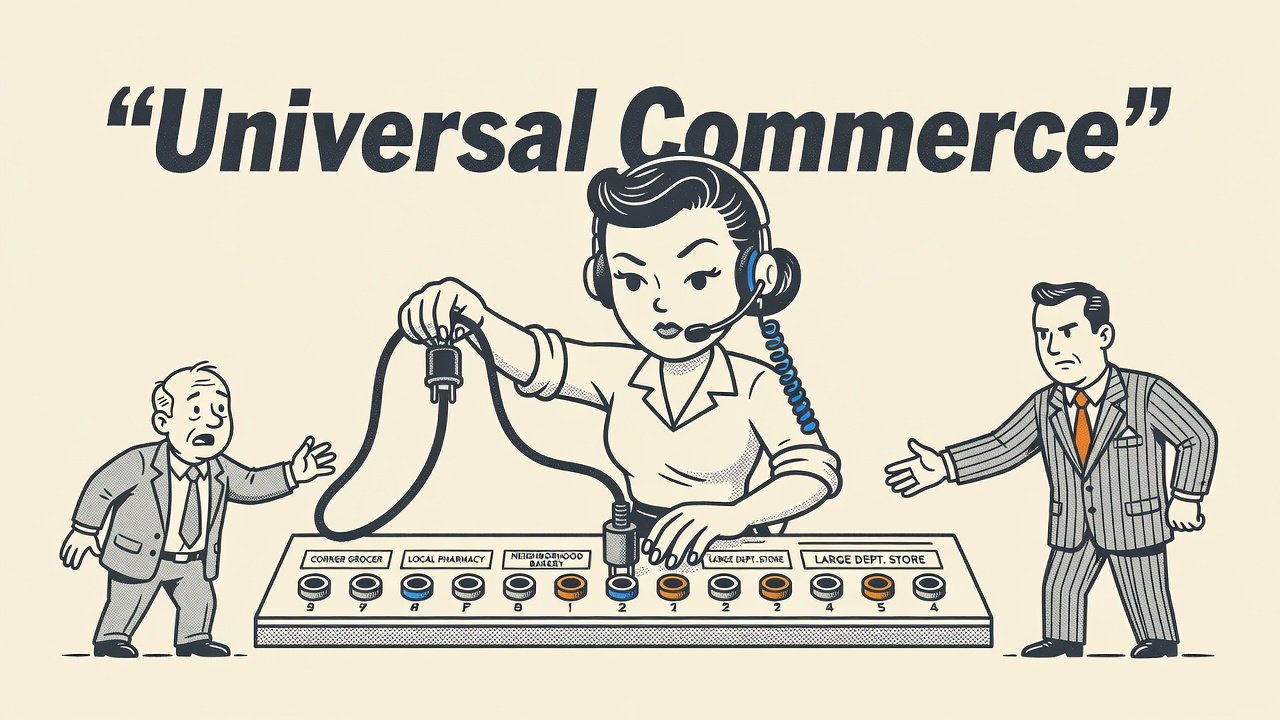
Universal Commerce Protocol is an open standard intended to unify digital commerce between businesses, AI platforms, commerce systems, and payment providers. It is not a marketplace, a new checkout page, or a replacement for your storefront. Think of it as a shared language that any AI agent can read to understand what your store sells, what shipping options you offer, what payment methods you accept, and how to complete a purchase on a shopper’s behalf.
According to the Google for Developers Universal Commerce documentation, UCP is designed to enable direct purchases inside Google AI Mode in Search and the Gemini app. The goal is to reduce checkout friction. A shopper asks an AI agent to find and buy a product, the agent reads your UCP profile, constructs a cart, processes payment using a credential the shopper has authorized, and returns an order confirmation, without the buyer ever landing on your product page. You retain pricing control, fulfillment responsibility, and the customer relationship throughout.
The protocol is modular and extensible. Merchants choose which capabilities to expose, so a store can begin with product discovery and add payment handling or order tracking later. No single capability is mandatory from day one, which makes gradual adoption realistic for smaller operations with limited developer resources.
How AI Agents Discover and Buy From Your Store
When an AI agent wants to shop your store, it starts by fetching your UCP profile from a standard location on your domain. That profile tells the agent which services and capabilities you support. The agent can then discover products, check inventory, build a cart, negotiate available payment methods, acquire a tokenized payment credential, and submit the order to your backend for fulfillment. Your payment service provider, such as Stripe or PayPal, handles the actual transaction.
UCP supports several communication methods, including REST APIs, Model Context Protocol (MCP), Agent2Agent (A2A), and embedded user interfaces. This range of options means UCP plugs into existing retail infrastructure rather than demanding a full rebuild. A store that already has a solid REST API for inventory and checkout is well positioned to extend that into UCP compatibility without starting from scratch.
The merchant stays Merchant of Record throughout the entire flow. That means you bear responsibility for the sale, tax collection, and the customer relationship, exactly as you do today. UCP handles discovery and transaction mechanics. Your existing systems handle the business reality behind the order.
The /.well-known/ucp Profile and What Goes in It
A core part of UCP is a machine-readable JSON file published at a standard path on your domain: /.well-known/ucp. This follows RFC 8615, the IETF standard for well-known uniform resource identifiers, the same mechanism browsers and security tools use to find domain-level metadata. Your profile at that path tells AI agents what your store supports: product search, cart construction, checkout flows, payment handlers, and order management endpoints.
Many stores can configure this file through their web server or CDN without a custom application server. The file declares the protocol version and the specific capabilities your store exposes. For a small store, an early version might list only product discovery and a basic checkout endpoint, with more capabilities added as your platform ships support for them.
Accuracy matters more than completeness. If your profile declares capabilities your backend cannot reliably deliver, such as real-time inventory or same-day shipping signals, AI agents will pass that information to shoppers and your fulfillment will fall short. Treat the /.well-known/ucp file as a live contract with the AI ecosystem, not a marketing document.
Worth Knowing: UCP payment credentials use tokenized payloads, not raw card numbers. Your payment service provider generates and validates the token. This means UCP does not change your PCI compliance burden: the transaction still flows through your existing payment integration, with the same liability rules you operate under today. No new payment security infrastructure is required on your end.
Product Data and Checkout Readiness Come Before Universal Commerce Protocol
Getting ready for UCP starts long before you touch a configuration file. AI agents reading your catalog will surface the same data quality problems that hurt your Google Shopping performance today: missing variant details, vague product titles, absent GTINs, and mismatched inventory signals. Use Schema.org Product structured data across your product pages and keep your Google Merchant Center feed synchronized with your live catalog. Run your URLs through Google Search Console and the Google Rich Results Test to catch markup errors before an AI agent encounters them.
Checkout reliability matters equally. UCP can route a shopper to purchase without visiting your storefront, so a broken payment flow or a session that expires before order confirmation produces a lost sale with no retry path on your site. Audit your checkout from a fresh browser session at least monthly. Know your payment success rate and address friction points before you open an AI-native channel that bypasses the safety net of a human shopper who can try again.
Platform Paths That Make Universal Commerce Protocol (UCP) Realistic for Small Stores
Most small merchants will not build a UCP integration from scratch. Shopify, WooCommerce, and BigCommerce are likely to ship native or partner-supported compatibility as the standard matures, following the same pattern as Shop Pay, Google Pay, and Buy with Prime. At its current stage, UCP is better described as early-specification than mainstream-ready: developer documentation is live but no major platform has publicly announced a general-availability release date for merchants. Watching your platform’s developer blog for beta-program invitations gives you earlier notice than waiting for a setting to appear in your merchant dashboard, and signals that your platform is treating UCP as a near-term priority rather than a backlog item. The table below outlines the three realistic adoption paths. Effort ratings are practitioner estimates based on typical integration complexity, not benchmarked findings.
| Adoption Path | What It Involves | Effort Level | Best Fit |
|---|---|---|---|
| Platform-native toggle | Enable a setting or install an official app when your platform ships UCP support | Low | Shopify, WooCommerce, BigCommerce merchants with standard catalogs |
| Payment provider integration | Connect a UCP-compatible payment handler through Stripe, PayPal, or similar | Low to medium | Stores already using a major payment provider with solid API coverage |
| Custom API build | Implement the full UCP spec via REST endpoints or an MCP server | High | Mid-market stores with dedicated developers and complex catalog requirements |
The Google for Developers Universal Commerce documentation outlines the full capability set and integration options. Reading it now gives you a head start in understanding what your platform will eventually configure on your behalf, and which capabilities your current infrastructure already supports.
Pro tip from Ronen Abudi, e-commerce and GEO specialist (ronenabudi.com): Publish your /.well-known/ucp file as soon as your platform supports it, even if the only declared capability is product discovery. Early, accurate presence in AI-indexed graphs tends to compound before the channel gets crowded, and clean capability declarations build trust with the protocol’s verification layer faster than a rushed, incomplete implementation.
Risks and Realistic Expectations for Smaller Merchants
UCP is a young standard. Tooling is immature, merchant documentation is sparse, and real-world transaction volume through AI agents is small relative to conventional search traffic right now. Treating UCP as an urgent action item is premature for many stores. Treating it as something to understand and prepare for is not.
The practical risks include inaccurate catalog data causing bad AI recommendations, payment edge cases your checkout handles poorly in automated flows, and attribution gaps where you cannot tie an AI-assisted order back to its source channel in GA4. If your order management system does not log the entry path, AI-channel revenue will blend invisibly into direct traffic and you will have no data to act on. To reduce that blind spot before AI-channel orders arrive: ask your platform or developer to append a UTM source tag such as utm_source=ucp&utm_medium=ai-agent to the post-purchase redirect or order confirmation URL; store that value as a custom order-source field in your order management system or Shopify order metafields; and register a GA4 custom dimension mapped to that field so you can segment AI-assisted revenue in your acquisition reports rather than watching it merge silently into the direct-traffic bucket.
Reduced direct storefront interaction is a subtler concern. A shopper who buys through an AI agent never sees your upsells, your brand story, or your email capture. The conversion happens, but the relationship-building touchpoints that drive repeat purchases are bypassed entirely. Plan now for how you will collect customer data and market to repeat buyers in a world where the first transaction skips your storefront.
Quick Takeaways
- UCP is an open standard that lets AI agents discover products, build carts, and complete purchases through your existing store backend without custom code on your side.
- You stay Merchant of Record throughout: your payment provider processes the transaction and your fulfillment rules apply exactly as they do for any other order.
- The /.well-known/ucp file at your domain root is your store’s machine-readable capability declaration. Treat its data like a live contract, not a wishlist.
- Clean product data, accurate inventory, and a reliable checkout are prerequisites that matter more right now than publishing a UCP endpoint.
- Reduced storefront visits mean fewer upsell and email-capture opportunities, so plan your post-purchase relationship strategy before AI-channel orders arrive.
Frequently Asked Questions
- Does a Shopify store need to build a custom UCP integration?
- Custom development is unlikely to be necessary for most Shopify merchants. As UCP support matures, Shopify is expected to ship native compatibility through its checkout and payment infrastructure, following the same pattern as Google Pay and Shop Pay. The practical step now is to watch the Shopify developer changelog and enable the feature once it appears in your merchant settings.
- Who processes the payment in a UCP-driven transaction?
- Your existing payment service provider, such as Stripe or PayPal, processes the transaction using a tokenized payment credential. The token is generated and validated by your payment provider, not by Google or the AI agent. Because the merchant stays Merchant of Record, tax liability and customer responsibility remain with the store owner, exactly as in a standard checkout.
- What is the /.well-known/ucp file and what does it contain?
- It is a JSON file hosted at a standard path on your domain, following the IETF RFC 8615 well-known URI convention. The file tells AI agents which commerce capabilities your store supports: product search, cart construction, payment handlers, and order tracking endpoints. Many stores can publish it through web server or CDN configuration without touching application code.
- Can an AI agent complete a purchase without the shopper visiting the store?
- Yes, and that is a primary use case for UCP. A shopper interacts with an AI agent in Google AI Mode or the Gemini app, the agent reads the store’s capability profile, constructs a cart, processes payment using a tokenized credential the shopper has authorized, and returns an order confirmation. The shopper may complete the entire transaction without loading a single page of your storefront.
- What should a small store do right now to prepare for UCP adoption?
- Prioritize catalog fundamentals before worrying about endpoints: publish accurate Schema.org Product structured data, synchronize your Google Merchant Center feed with live inventory, and audit your checkout for reliability issues under automated conditions. These steps improve your standing in AI-driven product discovery immediately and lay the groundwork that makes a future UCP integration straightforward rather than a scramble.